

Every shot between 130 and 180 used to cost me two numbers: the yardage I chose, and the yardage I should have chosen. I tried the phone app, which wanted a signal and a subscription and handed me front-middle-back numbers that never matched the flag. I tried the free card in my pocket, the sprinkler heads, and pacing off from the 150 stake. Most rounds I ended up trusting my gut, and my gut has cost me more strokes than my slice ever did.
Eighteen months in with a Callaway 300 Pro laser rangefinder, I can tell you the change was not that I suddenly hit every green. I still hit bad ones, plenty of them. The change was that I stopped guessing. Once the number was real, my club choice became real, and most of my bad approach play turned out to be a math problem, not a swing problem.
The part nobody tells you is that point-and-shoot is only half of it. Squeezing the button is the easy half. Building a routine that produces a true yardage under pressure, in the wind, with the group behind you waiting, is the other half, and mine has five steps. Here is exactly how I work a distance on a live round, including the mistakes I made so you can skip them.
Start With a Rangefinder That Locks On Fast
The whole method depends on a device that gives you a repeatable number, which is why I use the Callaway 300 Pro every round. The external slope switch is right there where I can see it, and it locks onto the flag quickly when the look is clean. It has lived in my bag for eighteen months.
Amazon Check Today's Price on Amazon →Step 1: Decide what you are shooting before you press the button
This is the step everyone skips, and it is why two playing partners can point the same laser at the same green and walk away with different numbers for the same shot. One is shooting the pin. The other is shooting the spot where the ball actually needs to land. Both readings are true. Only one is useful. Choose your target with the shot in mind, not the flagpole in mind.
My rule, learned from a season of doing this wrong, is to look at the shot first, pick the landing zone, and only then raise the rangefinder. If the pin is tucked behind a bunker and I cannot hold the green from short of it, I shoot the front edge and plan on the ball releasing toward the flag. If I am short-sided and have to fly it all the way in over trouble, I shoot the back of the green and take the whole ballpark. The rangefinder is a measuring tape, not a decision-maker. You bring the decision, it brings the number.
The other version of choosing your target is teeing off. On a short par 4 where the fairway runs out at 230 and the rough is dead, I laser the end of the fairway, not the flag, so I know what I am leaving myself. Reaching for the rangefinder on tee shots feels wasteful at first, but it keeps you from flying the corner into trouble your eye cannot judge.
Step 2: Get still, take two readings, and make them agree
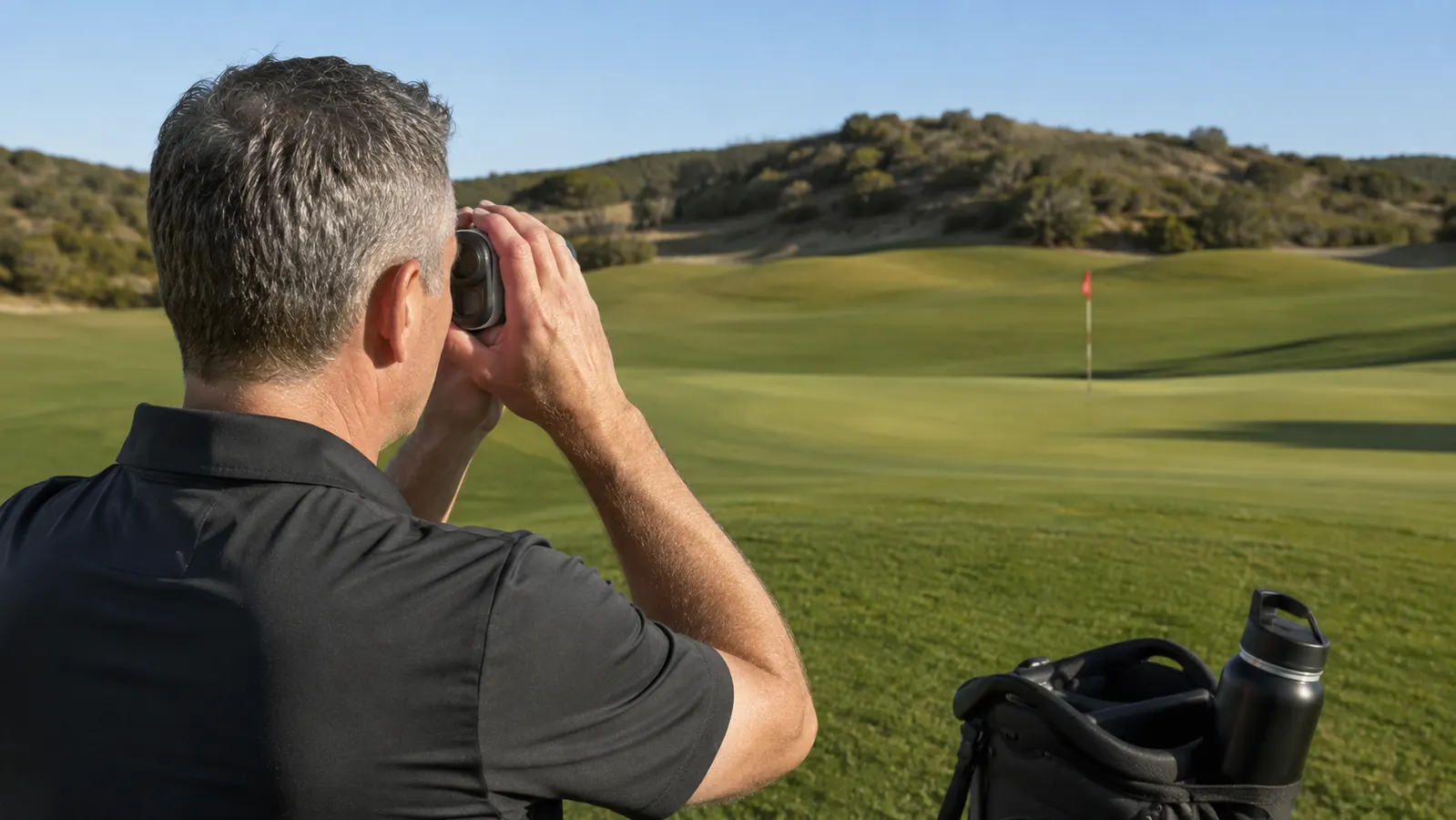
The biggest enemy of a good laser number is a shaky hand. The beam has to bounce off a thin structure a couple hundred yards out and come back, and a small wobble can grab the trees behind the green instead. I brace my elbows into my ribs, plant my feet, and go quiet the way I used to for a three-footer.
Then I do the part most people skip: I take two readings before I trust either one. If both numbers agree within a yard, I play it. If they disagree by more than that, one of them probably caught the backstop or a bunker lip, so I read a third time and take the repeat. Watch the caddies on any Sunday telecast and you will see the identical move, a re-read until the number lands twice. It costs five seconds and it strips most of the error out of the shot before the club is even out of the bag.
Waiting for the lock matters too. When the device confirms it has the flag, usually with a vibration or a flash in the display, that reading is the one you trust. If it never settles and just drifts, you are measuring whatever sits behind the green. A rangefinder in lock mode is only as good as the surface it is pointing at, so a clean look at the flag through the eyepiece is worth waiting two seconds for.
Step 3: Use slope honestly, and know when to turn it off
This is where the Callaway 300 Pro earns its place in the bag, because the slope switch is external. I can see at a glance whether it is on or off, and I can flip it mid-round in a second. Slope mode folds the uphill and downhill adjustment into the number, and on my home course a fifteen-foot elevation change is a full club. That is a real difference for a mid-handicap golfer on any course with undulation.
But here is the part that burns people. Under the Rules of Golf, slope readings are not allowed in competition, and events that permit rangefinders generally require slope turned off. So I practice with it off more than you would expect. If you groove every number with a slope adjustment and then show up to a tournament with it switched off, your 8-iron starts flying over greens, because you have been playing a slightly different game all season.
My personal take after a season of both: learn the raw number first, and treat slope as a bonus for casual rounds with friends. The raw number is the one that transfers everywhere, to strange courses, to match play, to days when you are not sure whether the clubhouse has a rangefinder policy at all. Slope answers one specific question. The plain yardage answers the one you ask yourself on every hole.

Step 4: Turn the number into a club, then into an aim
The rangefinder hands you the distance to the target. It does nothing about the other ninety percent, the wind, the lie, the grass under your feet, or the fact that your 7-iron carries 155 on a good day and 145 by the back nine. The number only helps if you know your own carry distances, and the best way to learn them is on the range with the same device you play with.
Here is the range drill that made it real for me. I hit my club of the day, say my 8-iron, and I laser the flighted landing spot for each swing, not the spot where the ball stopped. Carry distance is what matters on approach shots, because the ball lands before it rolls. Do that with ten clubs until you have a card you trust, then check it against on-course numbers as you play. Most amateurs discover their hero numbers are two clubs of fantasy.
Then the number becomes an aim. I used to pull a club on feel and aim at the flag. Now I take the locked distance, adjust for wind and lie, and aim at the fat part of the green more often than the pin. The exact yardage stopped me from chasing flags I had no business chasing, and that single change killed more bogey-plus holes than any swing article I have ever read.
Step 5: Make the laser part of one repeatable pre-shot routine
A rangefinder is a consistency tool, and it only works if you use it the same way every time. My routine is boring on purpose. Pick the target before the device comes up, brace, shoot with the slope in the state I want it, read twice, then step off the shot holding that number. Same order on the tee, same order in the fairway, same order in the rough. After a few rounds it takes about ten seconds and stops feeling like a gadget.
Do not let it become a crutch either. I never laser putts, and I rarely laser wedge shots inside fifty yards, because the carry to the front edge matters more than the pin and I can judge that with my own eyes. I also do not laser the same shot twice while my group waits, except when the first reading looks wrong. Knowing when the measuring tape does not help keeps the pace moving and keeps your playing partners from wishing you had kept the phone app.
One more thing about routine: use the rangefinder on the range as part of the warmup, not just on the course. Ten minutes of lasering your own landing spots does two jobs at once. It gives you accurate carry numbers and it makes the device feel like part of your hand by the time you stand on the first tee. A rangefinder you are comfortable with gives you real data without taking your focus off the shot.
What Else Helps
The device is half the battle. The other half is your own reference points, and that is why I keep a card in my bag with my carry distances on it, updated twice a season. The rangefinder gives me the truth, and the card tells me what to do with it on days my swing is not cooperating. Pair the two and you stop arguing about what is 150 and start arguing about what club you would hit at 165.
Batteries and care sound dull, but a rangefinder is only useful when it reads. I keep mine in its padded case when it rides in the bag, I check the battery at the start of the month, and I clean the lens with a soft cloth, not my sleeve. The Callaway 300 Pro has lived through a full season of pocket and cart abuse and still reads clean, which is more than I can say for the phone app I used to rely on.
If you are still deciding whether the whole category is worth it, my piece on the ten reasons a laser rangefinder improves your game is where I would start. And if you want the long view on this exact device, my eighteen-month review of the Callaway 300 Pro covers how it holds up, the battery life, and the small frustrations I would change. Both are honest, and neither pretends the tool fixes your swing.
The exact yardage stopped me from chasing flags I had no business chasing, and that single change killed more bogey-plus holes than any swing article I have ever read.
I want to be straight about the limits, because an honest piece needs them. A rangefinder will not repair a swing that is broken at the top, and it cannot tell you how the wind is moving forty feet up. What it does is remove the one variable you can control cleanly, the number, so your practice and your instincts have a fighting chance to handle everything else. That is a real edge, and it is one most weekend golfers leave on the table.
If you have never used one, the learning curve is roughly one round. It clicks around the third hole, the first time you laser a par 3 you were sure was 165, watch it lock at 178, and hit the club your shoulder was already telling you not to. The shot ends up flag-high, and you spend the walk to the green rerunning the math. That is the moment the device earns its place, and it is why mine has not left my bag since the day it arrived.
The First Locked Number Is the Whole Argument
Approach shots change the moment a guess becomes a number you can plan around. The Callaway 300 Pro is the rangefinder I reach for every round, and today's price is one click away.
Amazon Check Today's Price on Amazon →