

Last April, Ridgeview Municipal banned carts on the back nine until the summer dry spell, which is how a 47-year-old who likes to finish rounds before dark found himself carrying a golf bag up the longest hill in the county every Saturday. My old 14-way cart bag lasted exactly one trip. By the turn my left shoulder was numb and I spent the back nine hitching the strap up every third step. I ordered the TaylorMade Pro stand bag the next Monday out of pure spite. A full season later, with close to 45 walking rounds on it, that spite purchase is the single best piece of gear I own.
I am Marcus, 47, self-employed, and I get out twice a week in season. I follow football the way most of my foursome does, which means Sunday afternoons run long, and I keep up with soccer when it is on. I am not a gear expert. I am the exact guy this bag is aimed at, a mid-handicap recreational golfer who would rather spend the day swinging than carrying a weight around for four hours. This is the long-term review I wish I had found before I bought it: what actually holds up, what quietly annoys me, and whether the word 'lightweight' on the box survived contact with the real world. It mostly did. Here is the honest version.
The Quick Verdict
After 45 walking rounds on a course with real hills, it is the best carrying bag I have owned. The straps balance the load so well the bag disappears, and my only real grievances are a tight water bottle sleeve and a bag that is weather resistant but not waterproof.
Amazon Check Today's Price →The bag that carried my whole season
If you walk even one round a week, this is a decision your back and shoulders feel every single Sunday. Check today's price on the TaylorMade Pro stand bag and see where it lands.
Amazon Check Today's Price on Amazon →How I've Used It
Ridgeview is not a hard course. It is an exhausting one: 6,300 yards of up and down that climb roughly two hundred feet between the 13th tee and the 18th green, with a couple of short carries thrown in for the people who still choose clubs by feel instead of by rangefinder. People like me. I played it nearly every Saturday from April through October, plus some weekday nines, and I carried the whole time.
The TaylorMade Pro never lived a sheltered life. It rode in my trunk all summer, which turns into a greenhouse in July. It stood through a proper downpour on the 12th hole in early September. It came with me on a week of mountain golf in the fall over cart paths that rattled it sideways. I did not treat it like gear that needs protecting. I treated it like a bag whose job is to protect what is inside it.
The short version of the season is a single sentence: by July I stopped feeling my bag. When the thing on your back disappears, the walk gets shorter and the golf gets better. Everything below is the long version of why that happened.
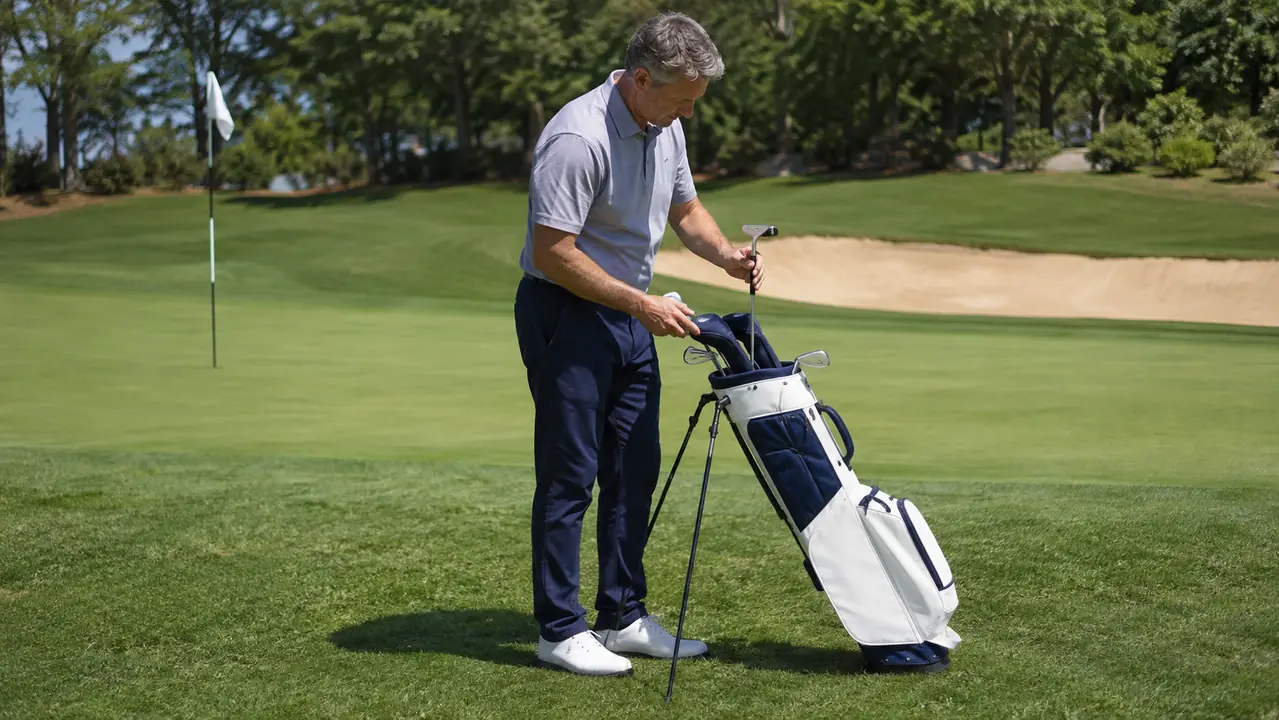
Straps First: Balance Is the Whole Game
The TaylorMade Pro is a dual strap bag, which every serious walker expects, but the contoured pads and the way the load rides high and close to your spine is what separates it from the pack. The straps adjust in about ten seconds at the first tee, and once you have them set they hold. The bag locks to your back instead of swinging off your hips, so the clubs stay quiet and your lower back is not doing the work your shoulders should be doing.
I am 5 foot 11 and about 185 pounds, and I keep the bag honest: fourteen clubs, a rangefinder, two gloves, rain gear unless it is the dead of August, and a water bottle I refill at the turn. Packed like that, the TaylorMade Pro rides lighter than my old bag did empty, because balance beats raw weight every time. My left shoulder stopped aching by the second week, and by July I had stopped re-tightening the strap on the 14th tee entirely. When a bag rides that well, you stop managing it and start playing golf, which is the whole reason anyone pays for a lighter carry in the first place. If you walk more than one round a week, that feeling alone is worth the switch, and it is the reason this bag never leaves my trunk.
I will add one setup note for anyone switching from a cart bag. The first time out you will spend two minutes at the first tee adjusting the straps, and that is normal. Set both pads so the bag rides high and centered, tighten until there is no slop, and leave it alone after that. By the second round it is muscle memory, and you will not think about it again. That is the real test of a carrying bag, whether the straps stop needing your attention by round two, and the Pro passes it.
Pockets: Everything I Carry, Right Where I Reach
The pocket layout is what finally retired the cart bag for good. There is a big apparel pocket that swallows a full rain suit, a fleece lined valuables pocket, deep ball and tee pockets, and room for a rangefinder I can get to without taking the bag off. The club dividers run the full length of the bag, so the grips stopped tangling when I reach into the middle of the set. That sounds small until you have pulled the wrong club for the third time in a round.
What I value most is where the pockets sit. The apparel pocket opens on the side facing away from your body, so I can get my hood out without undoing a strap and leaning the whole rig over. Nothing I carry daily requires unbuckling, which is the quiet luxury you only notice once it is gone.
There is one pocket complaint and it deserves a spot in the cons list below: the water bottle sleeve is a tight fit for a wide bottle, and the narrow bottle that fits comfortably is the one I forget at home. It is a small detail you find in week three, not week one.
The Stand, the Rain, and 45 Rounds of Abuse
A stand bag that does not stand is just a heavy satchel, so the legs matter more than the reviews admit. The legs on the TaylorMade Pro snap out when you set it down and tuck back when you lift it, and after 45 rounds, a week of rough mountain tee boxes, and a trunk that doubles as a hot storage unit, the mechanism still deploys clean every single time. I have watched cheaper bags develop a wobble by August. This one stayed planted on the uneven farm-road slope of the 14th tee.
Rain is the other test. That September downpour dumped everything the radar promised and a little more. The zippers held, the clubs inside stayed dry apart from what the walk itself put on them, and a bag heavy with water still came off my back without the straps digging trenches. I would not call it waterproof, because it is not. Truly waterproof bags weigh more and cost more. But for a bag that lives in the trunk and asks for nothing, the weather resistance has been plenty.
Two smaller things round out the durability picture. The base is a tough material that has taken the scrape of concrete cart paths and gravel every Saturday without showing more than light wear, no worse than any bag I have owned. And the whole thing stays light enough that you will actually carry it when you have a choice, which is the quiet advantage. A bag that makes you dread carrying it ends up left in the trunk, and then none of its features matter at all.

On a Push Cart Too, When the Cart Ban Lifted
The walking ban lifted in November, and for the last few rounds of the year I rode again up those same hills, which turned out to be a different kind of workout than carrying. The TaylorMade Pro sits flat on a push cart, which is exactly what the box advertises, and it rides in a motorized cart fine as well. The legs tuck out of the way and the base is stable. If your season is walking in the spring and riding in the dog days of August, this bag does both without a single compromise.
On the cart is where I will be honest that a big cart bag has an edge: it simply swallows more, and weight stops mattering the moment the cart does the walking. The Pro does a lot of everything instead of owning one job. But for a golfer who walks more than he rides, which is who I am, the trade is not close. I have not missed the cart bag once, and that includes the month it sat in the garage while the Pro went on the mountain trip.
Alternatives I Considered and the Honest Tradeoffs
I got close to a Titleist Players 4, and my regular partner swears by his Sun Mountain. Both are excellent bags and I would not argue with either choice. The TaylorMade Pro won for me on two specifics I could not see on a store page: the strap geometry sits higher on my shoulders, and the full length dividers stopped the club tangling that had been driving me crazy. If you can, put the bag on your back in a store before you buy. A weight number on a website tells you nothing about how a loaded bag rides on your body, and that is the whole game.
In the interest of an honest tradeoff, though, no bag does everything, and the Pro trades a little storage to earn its lightness. On the cart it gives up the sheer holding capacity of a true cart bag, and in a heavy storm it will hand the keys back to a rain hood. Those are the two places the compromise shows. For me they are the right trades to make, because I carry more than I ride and I play in the sun more than I play in a monsoon. You should decide which side of those trades you are on before you spend a dollar.
What I Liked
- Straps balance the load so well the bag disappears on your back
- Full length dividers stop the grips and shafts tangling together
- Fleece lined valuables pocket that stays easy to reach
- Stand mechanism still snaps clean after a full season of abuse
- Works as well on a push cart as it does on your back
Where It Falls Short
- The water bottle sleeve is too tight for a wide bottle
- Weather resistant but not waterproof, a real storm needs the rain hood
- On a cart it cannot match the storage of a true cart bag
Packed for a real round, the TaylorMade Pro rode lighter than my old bag did empty, because balance beats raw weight every time.
Who This Is For
The TaylorMade Pro stand bag is for the golfer who walks. That sounds obvious, but plenty of stand bags get bought by riders, and riders should keep their cart bag. If you carry at least once a week, if your course has any hill in it, if your shoulders have a quiet memory of the 14th tee, this is the answer. It is also for the golfer who wants one bag to do everything, walk the weekday nine, sit on the push cart Saturday, ride the mountain trip in the fall, because the Pro does all of it well enough that you never feel the compromise.
Who Should Skip It
Skip it if you ride almost every round. On a cart you are carrying a stand bag's compromises for no benefit, and a real cart bag with more storage will serve you better. Skip it if you need truly waterproof, because this bag shrugs off a shower and gives the keys back in a storm. And skip it if your idea of a round is four towels and a Bluetooth speaker, because the Pro is built to carry golf clubs, not a club house. One more honest note: if your course is cart only and you never walk anymore, the Pro's lightness earns you nothing there, and the storage compromise costs you the one thing a cart bag gives back.
One season in, this is the easiest recommendation I make
Your swing will do what it does on the day. Your bag is a decision you make once and then live with for four hours a week. Check today's price on the TaylorMade Pro stand bag and see if it is the walking bag your back has been asking for.
Amazon Check Today's Price on Amazon →