
You can spend better money than a laser rangefinder. I just have not found it yet. For the past two seasons the Callaway 300 Pro has lived in the easy-access pocket of my bag, and it is the one piece of gear that has changed the way I think on the course. Not how I swing the club, which is as flawed as ever. How I decide what to swing, which is where the strokes actually live. I did not expect that. I bought it in a hurry before a trip, telling myself I would use it every round, and it turned out I was right for the first time in a long time.
I play a couple of times a week, most of it on a municipal course with a few blind holes and a lot of sloping greens. Before the rangefinder, every approach shot started with a guess. Now each one starts with a number. Here are the ten ways that has improved my game, in the order I noticed them.
Know the number before you swing.
The Callaway 300 Pro gives you a true yardage and an honest slope read in about three seconds, and it fits the same pocket you reach for your glove in. It is the rangefinder I play with every week. Check today's price on Amazon.
Amazon Check Today's Price on Amazon →It Kills the Guessing on Every Approach Shot
Even a 10-yard error on a mid-iron is the difference between a birdie look and a two-putt. For years my approach numbers came from a rough estimate and a hopeful stride-off, and when the estimate was wrong it was usually wrong in the direction that hurt. Now the number is real: 146 to the pin, not 'about 150 if it is playing the way it usually plays.' The whole 'was that a 7-iron or an 8-iron?' conversation is over before it starts, and my misses are closer to the hole.
Flag Lock Finds the Flag, Not the Traps Behind It
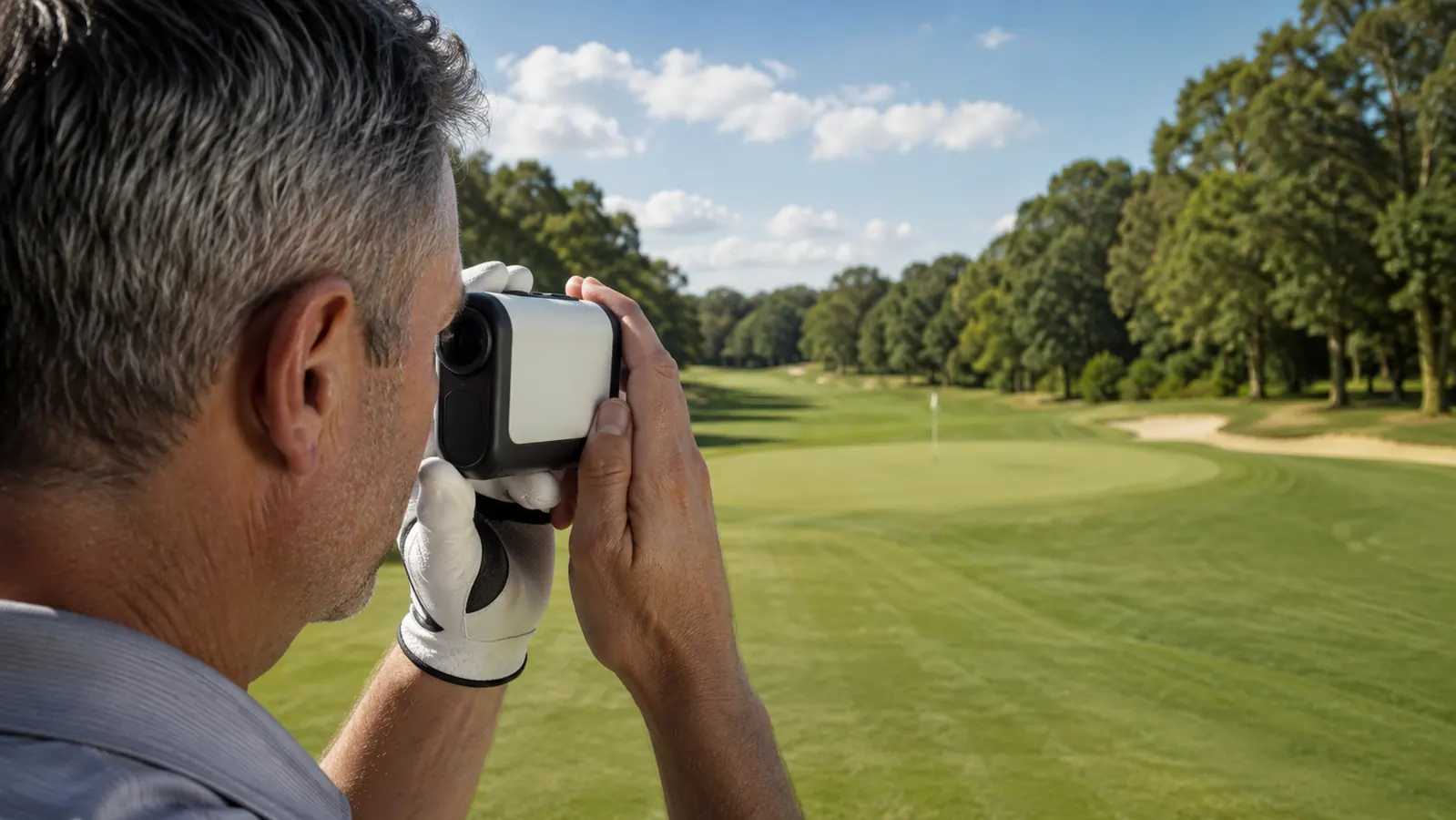
The trick that sold me: point at the flag, hold steady, and the Callaway 300 Pro locks onto the pin even when the background is a busy treeline or a cluster of bunkers. It shoots to the flag, not to whatever sits behind it. You do not need a rock-steady hand or a tripod, just a few seconds of still. On a crowded course that is the difference between aiming at a real target and aiming at something that just looks like one.
Slope Mode Tells You How It Actually Plays
Uphill lies lie to you. The 300 Pro has an external slope switch, so I keep slope on for practice rounds and flip it off for league night where the rulebook cares. When the green is eight uphill I now know exactly how much to add. On our 12th hole the green sits a club and a half above the fairway, and it stopped kicking my card. The club I hit on that hole changed the first week, and the putts started dropping.
Between Clubs? The Number Breaks the Tie
The worst swings in golf come from standing over the ball unsure. When the rangefinder says 158 and my 7-iron goes 150, I hit the 6. When it says 141, I hit the 8. No more flipping a coin while I settle in. I used to lose a shot to that coin every couple of holes. The uncertainty that used to cost me is gone because the decision is already made.
Your Pre-Shot Routine Gets Faster
Slow play is a sin and guessy play is slow play. Because the number comes in a few seconds and is trustworthy, I stop pacing, stop squinting, stop asking my playing partner what he has. My last round with the Callaway 300 Pro moved at a good pace, and my group thanked me for it. There is a rhythm to a round that moves, and your playing partners feel it. Faster decisions, fewer wasted rehearsals.

You Aim for the Middle With a Real Number
Sunday pin placements are a trap. When the flag is tucked behind a bunker, the smart play is often the middle of the green. With a real yardage to the center, I pick a target I can actually hit and let the two-putt be the victory. The result is fewer doubles and more pars, which is what a mid-handicap round is built on. That is the whole scorecard math right there.
Your Wedge Distances Turn Into Numbers You Can Repeat
I used to hit wedges by feel, which meant every round was a fresh experiment. Now the rangefinder gives me exact distances and I write down what each swing produces. Three quarters, half swings, knock-downs all have numbers attached. A month of that and the 60-yard shot that used to scare me is now my favorite club out of the bag. It turned my least-favorite yardage, the gap between a full swing and a half swing, into a shot I own.
Blind Tee Shots Stop Being Prayers
My home course has a pair of blind tee shots where the fairway runs out at a spot you cannot see. One laser read on the way past and I know exactly where the trouble starts. I have stopped losing balls to holes I could not see, and I have stopped laying up short of a green I could have reached. The guys I play with noticed before I said anything.
Par 3s Finally Get the Club They Deserve
Every par 3 on my course sits higher than the tee, some by a full club. I used to guess, blame the wind, blame my swing. Now I shoot the flag, check the slope setting, and pick the club the number says to pick. The par 3s went from card-wrecking holes to ordinary golf holes, and the scorecard noticed. A par 3 is the one hole where the club choice is everything, and now I am never guessing it.
Confidence Is the Quiet Win
Golf is a game of committing to a shot. When you believe in the number, your hands stay soft and your swing stays free. The Callaway 300 Pro did not fix my swing, it fixed my commitment. Half the game is believing the shot you have chosen is the right one. That alone has put strokes back in my pocket, and it is why the rangefinder rides in the bag every single round.
What I'd Skip
Not everybody needs this. If you play nine holes a month, ride a cart, and have never once wanted an exact number off a flag, a rangefinder is a solution you have not asked for. If your ball striking is so scattered that a 12-yard decision is noise, get a lesson first. And if your course is flat as a parking lot, slope mode is a feature you will rarely touch. The Callaway 300 Pro is a great tool. It just has to be a tool you will actually use.
The rangefinder did not change my swing. It changed which club I swing, and that is where the strokes went.
Give the numbers a try this season.
If you take one thing from this article, take this: an exact number beats a good guess every single time. The Callaway 300 Pro is the rangefinder I trust for every round, and it is the one I would buy again tomorrow. Check today's price on Amazon.
Amazon Check Today's Price on Amazon →