
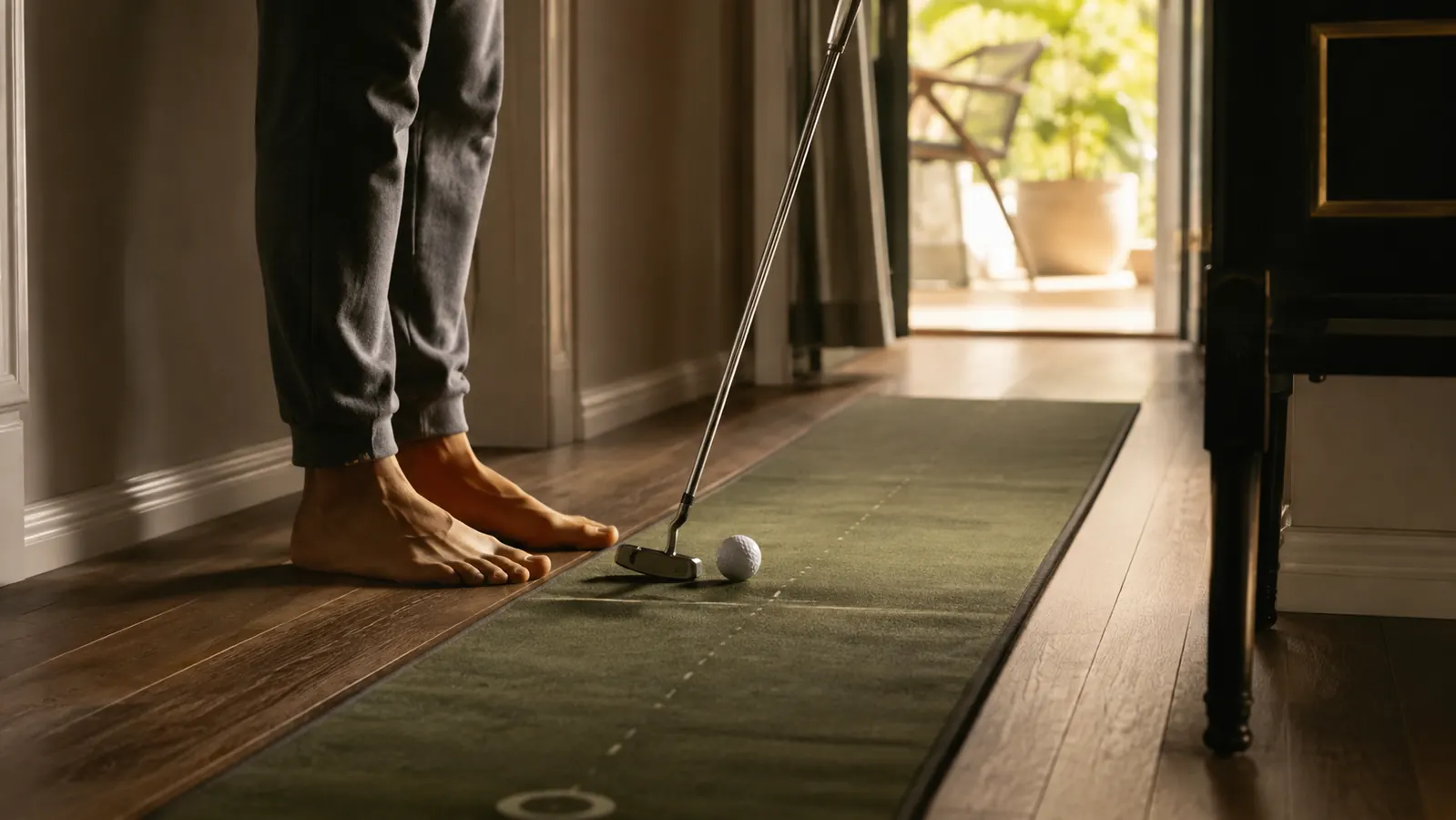
My putting went to pieces last winter, and I blamed the aged hands and the fact that I could not get to a green. I was wrong about both. The real problem was that when I finally did drag the practice mat out of the closet, I rolled a handful of balls, got bored, and called it a session. Twenty aimless rolls do nothing for your score, and that is the exact mistake most of us make with a home putting mat.
The fix was not a new putter and it was not more time. It was a routine with a purpose. I have been running the SKLZ putting green mat in my hallway for about four months, ten focused minutes most nights, doubled on rainy weekends when the course is out. The strokes came off in ways I did not expect and my confidence on four-footers stopped wavering. Here is the exact way I set it up and practice, so you get actual improvement out of your night instead of boredom.
Ten Bored Minutes Made Me a Worse Putter. These Ten Focused Ones Fixed It.
The whole routine below works best on a flat, consistent practice mat. Start the night by setting up on the SKLZ putting green and you will know your roll is true before a single stroke.
Amazon Check Today's Price on Amazon →Step 1: Set Up Your Mat Where You Will Actually Use It
The biggest lie in home putting is that you need a dedicated room or a garage. Those are nice, but they are also why the mat stays in the closet. If a mat takes effort to reach and five minutes to set up, you will not use it more than once. Put it where it is already out: a hallway, a spare bedroom, or one corner of the living room that does not get walked across.
I run the SKLZ putting mat down a short hallway where the floor is flat and even. That matters. A mat on an uneven carpet makes every putt break wrong and teaches you bad habits. Flat flooring, no wrinkles under the mat, and a stop at the end so the ball does not roll on forever. Ten seconds of setup tonight means it is out and ready every single night. That ease is what actually gets the reps in.
Give yourself as much run as you can. The SKLZ mat is long enough to practice the putts that actually decide a round, the four-to-six-footers, plus the short lag putts that a weekend round is usually won on. Mark your normal starting spot with a strip of tape so your target distance does not wander night to night. A settled setup is half the battle, because every practice session then measures the same thing.
Step 2: Build a Repeatable Setup Before You Roll
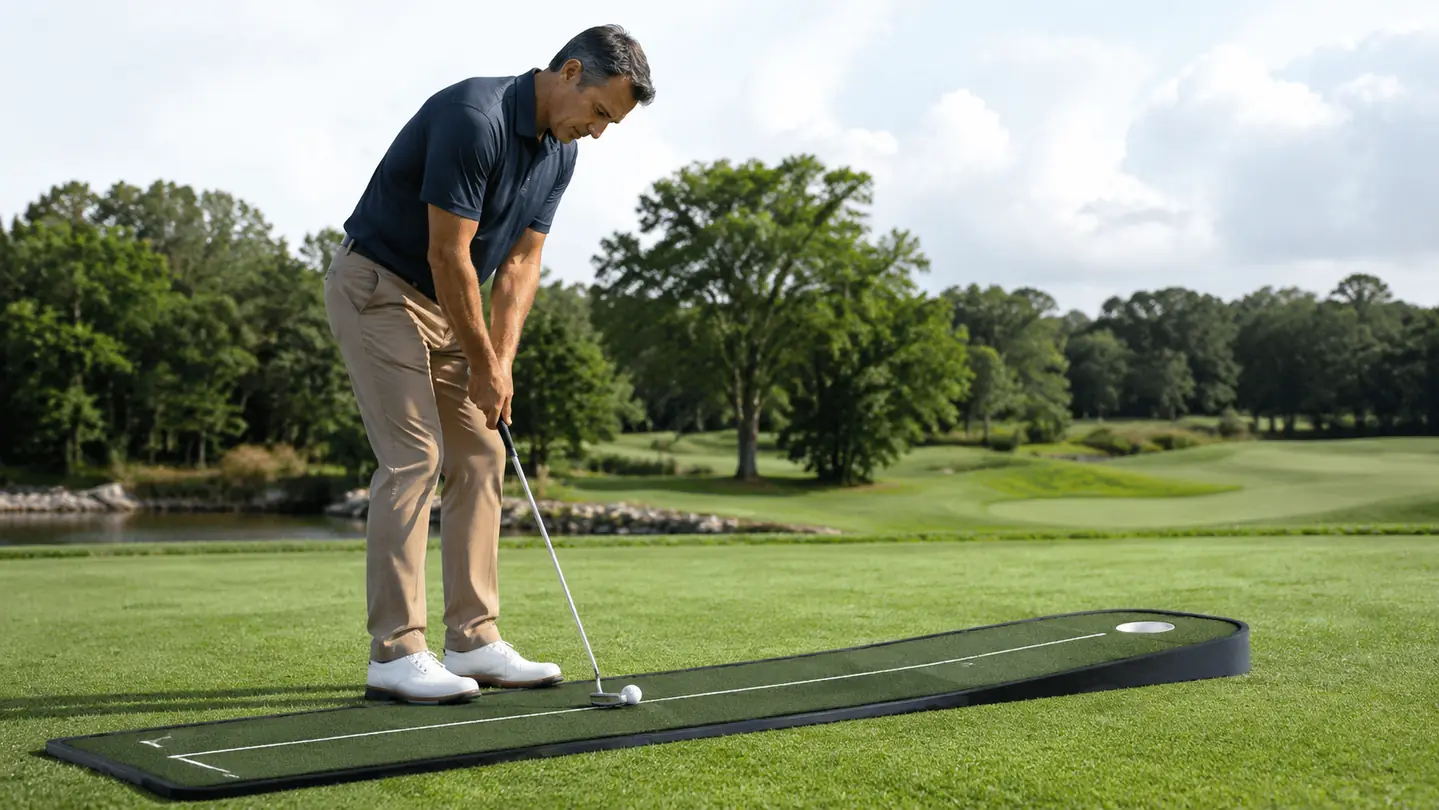
Before the first ball moves, set your putter down with the face square to the target line and take your stance. Eyes over the ball or just inside it, grip pressure light, and the putter resting flat on the mat with the sole flush against it. You want the same address position every single time, because a putting stroke is a habit, and you are building the habit here at home where nobody is watching.
The SKLZ mat has guide lines that keep your alignment honest, and that is genuinely useful at home where there are no course cues to hide behind. Use that line for the first ten rolls each night with no ball, just a pendulum motion from the shoulders. Small strokes, watch the face stay square through the line, ignore the result for now. Feel the repeatable motion before you worry about making or missing a putt.
Keep the stroke short and the tempo even. A home mat tempts you into big, fast swings because there is no real speed to judge against, but that trains a jab. Let the putter swing on a clock pendulum, back and through at the same pace, and let the length of the swing carry the distance rather than snapping at it. Even, soft, and repeatable beats strong and violent every time on a putting green.
Step 3: Nail Distance Control Before Anything Else
Most weekend golfers lose more strokes to distance than to line. An eight-foot putt missed by six inches left is a missed read, but an eight-foot putt left six feet short is a distance-control failure that no green reading will ever fix. So spend the first half of every session on how far the ball rolls, not where it goes.
Pick one target on the mat, the far edge or the cup, and roll ten balls trying to stop each one at the same spot. The SKLZ putting green gives you a clear cup to aim at, so I use the front lip. Ten balls, all finishing within a glove-length of each other. When they do, that is your length. Then change the target to a different distance and repeat. Distance feel is built by this exact repetition, the same mechanic every night until it is automatic.
If you want a number to chase, the mistake I cared about was the three-putt. On the course, my three-putts came almost entirely from leaving the first one too short or blowing it six feet past. Ten focused minutes on length, every single night, cut that more than any other single change I made. Distance is the part of putting you can fix at home and bring straight to the first green, so it deserves the most attention.
Step 4: Add a Gate Drill for a Square Stroke
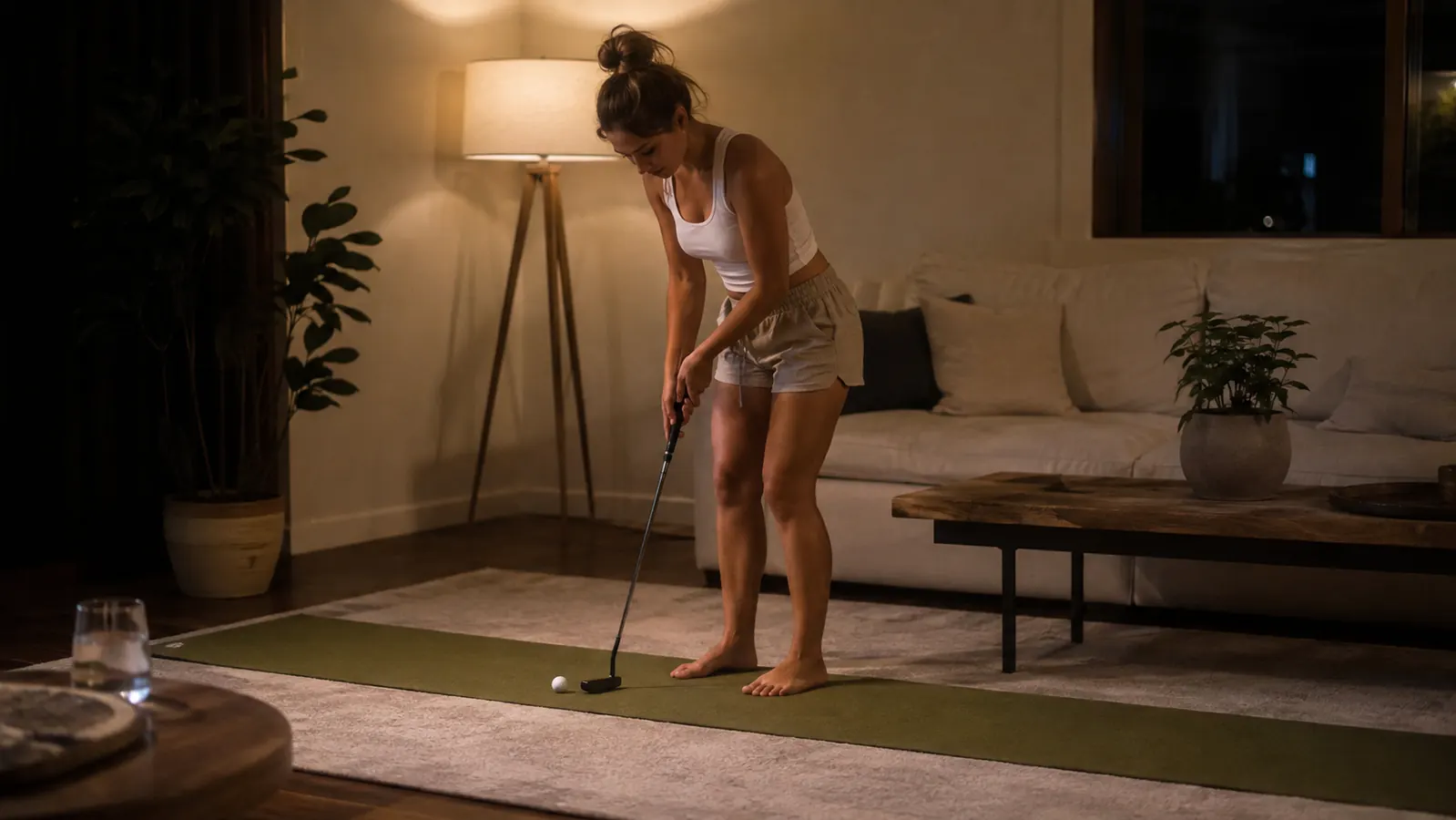
Once distance feels like second nature, tackle the stroke itself. Set the putter head down and build a gate, two tees or two coins just wider than the putter face on either side of where you address the ball. Roll putts through that gate with a smooth stroke, keeping the face square so it does not clip either side. You are training the blade to stay on line through the impact zone.
I do fifteen gate putts a night on the SKLZ mat and it is the single drill that most cut my misses down. When the ball goes through the gate dead straight, I trust the line. When it leaks, it is always the same two faults: I either opened the face or I jabbed at it. Naming the fault beats just being annoyed, and the gate shows you which one it is every single roll.
Do the gate slowly at first. There is a temptation to speed through reps to feel productive, but a rushed gate drill teaches the club nothing. Roll each putt with the same deliberate pace, watch the face stay square between the tees, and only speed up once the ball is going through clean every time. Slow and correct builds the memory. Fast and sloppy just locks in the same bad stroke you already had.
Step 5: Turn It Into a Ten-Minute Routine, Not a Grate
Here is the structure I actually keep, and it fits in ten minutes. First two minutes: repeatable setup, twenty no-ball strokes on the line, just feel. Next three minutes: distance control, ten balls to each of two targets. Then three minutes: the gate drill, fifteen rolls. Last two minutes: putts that count. I set up three balls and make myself make all three from four feet and six feet before I am allowed to stop.
That last part is the part most home practice skips. You need some pressure to build the habit of making putts, and a little personal consequence works. If I miss, I start the three-ball round over. On a good night it is quick. On a bad night I am down there for twenty minutes and that is fine too, because a bad night at home beats a bad night on the first green every time. The SKLZ putting green never changes on me, so when I do well on it, I know I am the one improving.
Once every week or so, swap the routine a little to keep it honest. Move the mat to a different flat spot, aim at a mark instead of the cup for part of the night, or roll with your eyes closed to build pure length feel. Variation stops the session from becoming automatic in the wrong way. The repetition stays, but a small change forces your hands to actually think about each putt again.
What Else Helps
A few extras make the whole routine stick. Do it at the same time each night, right after I clear the dinner table, so it becomes the default hour instead of a chore I negotiate with. Keep the mat flat and the floor swept, because a speck under the mat makes every putt give a little hop. And once a week, take the same ten-minute routine to the practice green at the course. The carryover is real, and it tells you where the mat is teaching you one thing and the real grass another.
One honest note on the SKLZ mat: it rolls fast and dead flat, which is not the same as a mounded course green, so spend part of the course session on breaks and undulation. But the stroke you build at home, square and controlled and repeatable, travels with you. That is where the score gets saved.
Do not overdo it. When the stroke starts looking lazy or frustration creeps in, that is your cue to stop for the night. Five good minutes beat twenty sloppy ones, and a tired hand will undo the good feel you built. Home practice is about steady habit building, not punishment. Keep it short enough that you look forward to it, and you will actually keep showing up.
Twenty bored rolls never improved my putting. Fifteen gate putts and three made from four feet, every single night, is what actually took two putts off my round.
The Result You Should Actually Expect
Be realistic about what four months of home putting did for me, and you will know what to expect out of your own. My two-putt rate went up, plain and simple. I stopped giving back the approach shots I hit well, because I stopped leaking four-footers. My short misses became rare and my long lag putts started finishing close enough that my par save looked routine instead of heroic. That is the honest payoff of a mat you actually use.
It is not magic and it is not a shortcut, and anyone who tells you a putting mat alone fixes your game is selling something. What it does is give you the reps with the right structure, and reps with structure are the whole game. If you have been meaning to practice at home and keep not doing it, the problem was never your hands. It was the plan. Ten minutes a night, this routine, on the SKLZ putting green, and the confidence you feel on the first green on Saturday is worth the floor space all by itself.
Keep it simple to track. I jot a note on my phone after each round, the number of putts and how many three-putts, nothing fancy. Two months in the trend lines pointed the right way, and watching them move was the motivation that kept the ten-minute nights going. Numbers beat vague feelings, and the scorecard is the only honest measure of whether the home practice is working.
You Already Have the Putter. Give Yourself the Flat, Repeatable Practice Surface.
The whole routine above needs a consistent mat that does not change on you from night to night. The SKLZ putting green lays flat in a hallway or spare room and gives you a real cup to aim at.
Amazon Check Today's Price on Amazon →