
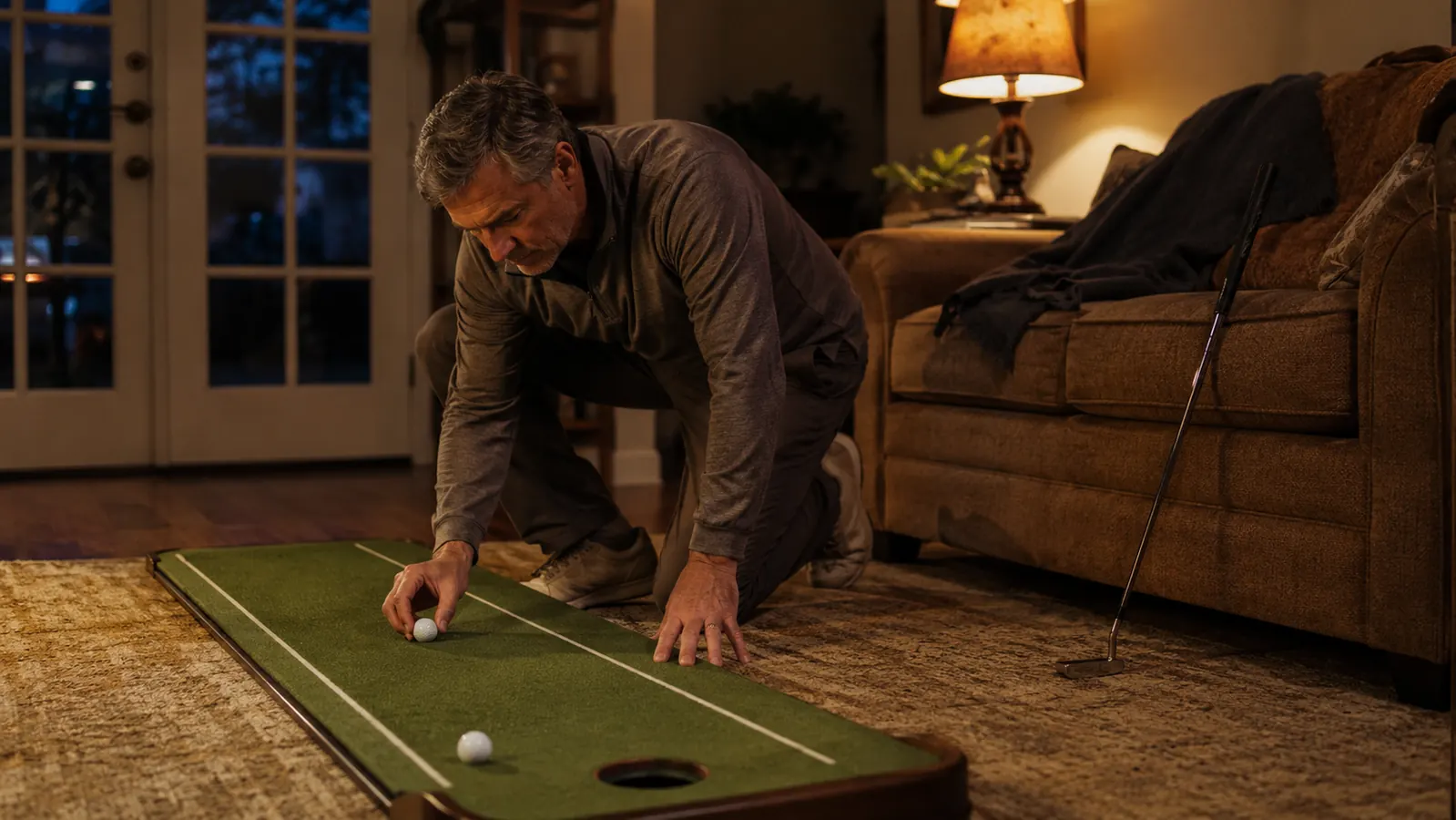
Winter is where the good summers get decided, and for most of us in the northern states that winter was the whole problem. I would play a couple times a week from April through October, my swing felt fine, and then every February I would walk off a course I had no business tripping over with 36 putts on the card and blame the cold and the greens and my own shaky hands. It took me years to admit the obvious thing sitting right there in my own scorecard, that the part of my game leaking the most points was the one part I never did a single rep on.
The honest diagnosis was a lot less romantic. I did not practice putting, ever. I hit mid-irons on the range until my hands bled, but the ten-footers that decide whether a round lands at 84 or 79 got nothing from me between October and March. So last September I cleared a corner of the living room, unrolled the SKLZ Putting Green, and decided to do ten minutes a night. Not an hour, not a serious program, ten minutes. That decision, plus this mat, quietly took two putts a round off my score by the time May arrived.
The Quick Verdict
Ten minutes a night on the SKLZ Putting Green did more for my score than any lesson I have paid for in the last five years, because it fixed the one part of my game I never worked on.
Amazon Check Today's Price →The Mat That Finally Made Me Practice Putting
If your short game is the weakest thing on your card and your winter is too long to ignore it, this is the lowest-effort fix I found. A practice strip that lives where you actually spend evenings, not in a bag you have to drive to.
Amazon Check Today's Price on Amazon →How I've Used It
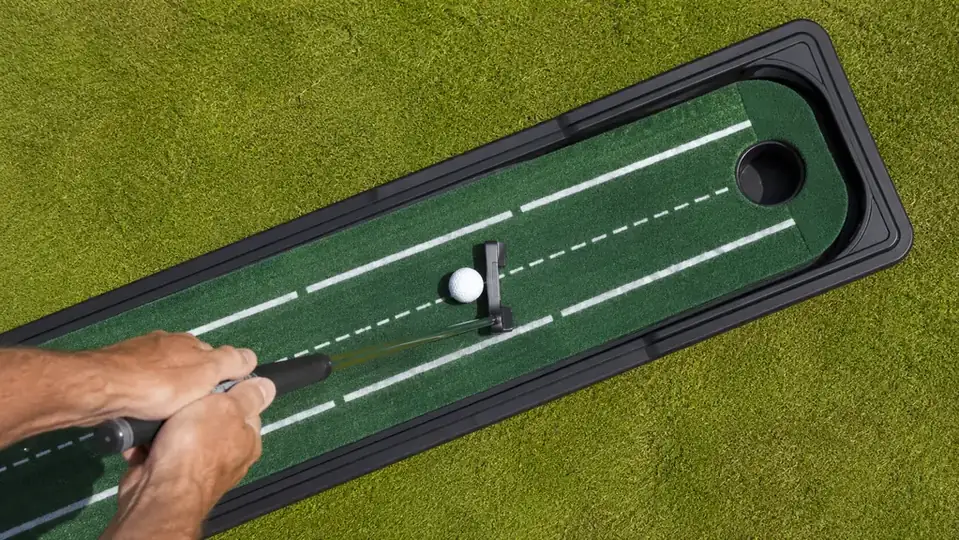
I did not follow a program. I did the same three things almost every night, usually while dinner was cooking or after the ten o'clock news started. First, I drilled the six-foot putts back and forth along the checkered strip until my start line stopped swaying. Second, I worked the three cups this version gives you, aiming at each one from the same spot so I could feel how a small change in path changed where the ball finished. Third, and this was the real core of it, I spent most of my ten minutes on distance control with no target at all, just rolling the ball with a feel for pace and watching it die near the far edge every time.
That is not a glamorous routine and nothing about it felt like training. It felt like a kid playing on the living room floor. That is exactly why it worked. When practice feels like a chore you skip it, and I have skipped more practice routines than I can count. Ten minutes on the SKLZ mat became a habit because it was pleasant, short, and there was nowhere else to go at ten at night in January anyway. I did not put on golf clothes or clear my schedule or drive anywhere. I just grabbed the putter off the rack by the back door, walked the four steps to the mat, and rolled a few.
I kept a little tally on my phone, one line for every night I actually did it, and I was honest about the nights I skipped because of a late dinner or a Sunday football game running past eleven. Out of the roughly 210 nights from September through April I managed around 180. That is a lot of quiet reps, and the reps were all on the same flat surface, which is its own caveat I will get to honestly below. The whole point was that the habit outlasted the novelty, and it did, which surprised me more than the score change did. It is one thing to buy a trainer, it is another to still be using it, unsupervised, in the middle of February.
What Ten Minutes a Night Actually Changed
The first thing to go was my fear of the short putt. I used to stand over three-footers the way I stood over a full swing with water on the left, tense and half-committed. After a month of rolling fifty of those a night on a strip where I could see the line, the stroke felt automatic on the course in a way it never had. That is not a mystical thing, it is just reps against a visible target instead of against a story in my head about how much the putt means. You stop thinking and start repeating, and repeating is what makes a stroke trustworthy.
The second change showed up on long putts and it was the more valuable one. On a mat with no break and a known speed, you can finally feel what a dead-hit putt does at three different lengths. You learn a pace that stops the ball right at the hole instead of flying six feet past. That transfer to real greens is undersold in every putting mat review you will read, because mats are sold as line trainers, but for a mid-handicap player the distance control is the bigger win. The lag putt is where the big numbers get parked, and it is the first thing a flat practice strip corrects once you stop chasing the hole and start chasing the right roll speed.
The transfer that matters is not the line, it is the pace. On a flat mat I learned what a dead-hit putt feels like at ten and fifteen feet, and that feel carried to the course more than any aim drill.
The Real Numbers From My Scorecard
I track my stats in a paper notebook in my golf bag, and this is the honest part. My average putts per round over the two seasons before I owned the mat hovered between 32 and 33. Last season, the one after a winter of ten-minute nights, I averaged 30.1. Two full putts a round, and those putts showed up where my old game leaked the most, on the 20-to-40-foot lag putts that turned three-putts into two-putts. That is the difference between breaking 85 and grinding out an 87, which for a weekend player is the whole ballgame.
My three-putt rate dropped from roughly 2.4 per round to roughly 1.1. That alone is a couple of strokes, and it happened without touching my full swing at all. I am not a low-handicap player, which is the whole point. The closer you are to 90, the more your scorecard is ruled by the flat stick, and that is exactly the territory where a patient winter of simple reps pays off fastest. The mat is a four-foot practice strip, not a magic wand, but the numbers are what they are and they came from a habit I kept for eight months because the mat made it pleasant.
What the Mat Does and Does Not Teach You
Be clear-eyed about the limits, because nobody else is going to tell you. The SKLZ Putting Green is dead flat and it rolls at one constant speed. That is its strength and its ceiling. It will not teach you to read a breaking putt, it will not teach you how your home course runs in the afternoon, and it will not build the touch you need on glassy tournament greens that are twice as fast. If your whole problem is green reading, or you only miss putts on heavily tilted surfaces, a flat strip is not going to touch that. You need a real green with real contour for that, and no amount of carpet turf changes the math.
What it does teach you is path and pace on a straight putt, and for most recreational golfers, myself included, that is 80 percent of the problem. Your start line sways and you have no feel for distance. This mat attacks exactly those two things, which is why it helped me. The moment you stop being genuinely bad at the flat six-footer, the mat has done its job and you can keep doing the first two minutes of your routine on it forever while the rest of your practice moves to a real green. I still roll on it most nights in season too, not because it is exotic, but because keeping the stroke locked in takes five minutes and stops me from drifting.
Setting It Up and Living With It
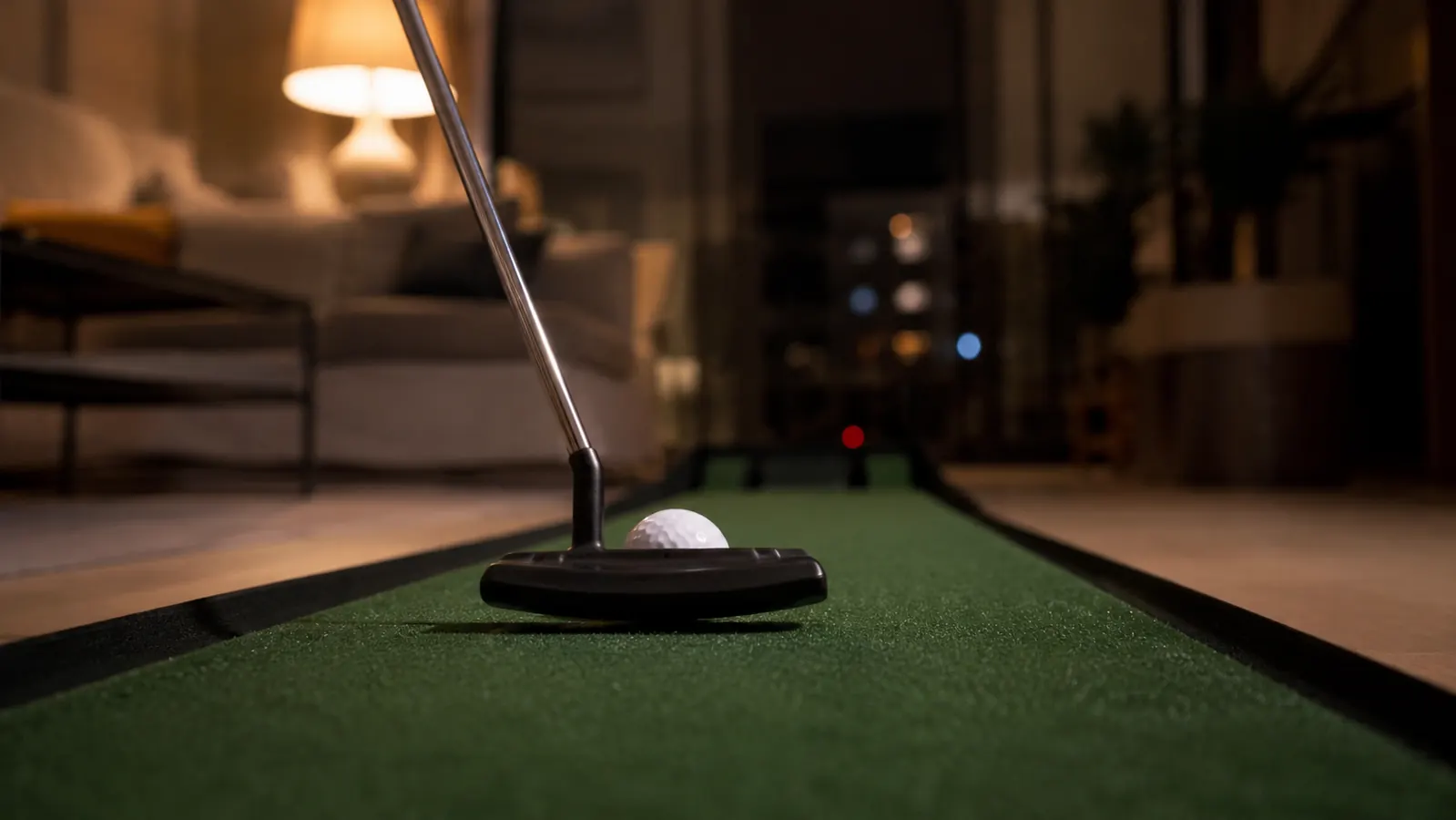
Setup is the roughest part of owning a cheap putting mat, and the SKLZ is no exception. It arrives rolled up tight, and for the first few weeks the edges want to curl on you. I solved it by laying it under a heavy rug for a couple of days to flatten it, then pinning the corners with books that have been sitting in my study since forever. Once it is flat it stays put on carpet, but on tile or bare wood you will be chasing it across the floor every few putts unless you anchor it. A couple of carpet tiles or a strip of grip tape under the ends fixes that in about two minutes, and it is worth doing on day one.
Now that I have the setup dialed, unpacking it takes me all of thirty seconds and it folds small enough to slide behind the sofa during the day, which matters if you do not want a putting mat as a permanent conversation piece in your living room. My kids know to leave it alone, and it has survived a full winter of nightly use plus one genuinely careless elbow from a teenager watching soccer, and it still rolls true. Ten minutes a night is the magic number for me because it fits between the end of work and the start of the evening, no drive to a range, no standing in the cold, just a putter and a strip of turf and a quiet house.
Build Quality and the Honest Downsides
The SKLZ mat is a roll of textured golf-turf material with a ball-return channel and a couple of molded cups. It is not a putting green you would mount in a spare room and show off. It develops visible wear lines after a few months of nightly use, the seams between the strip sections are obvious, and the ball can hang up on the seam if you let the mat wrinkle. You have to lay it flat, and you have to be willing to accept that it looks like what it is, a practice tool, not furniture. That honesty matters, because half of the disappointment people feel with any home putting mat comes from expecting showroom polish that the price never promised.
The ball return is simple and it works, but the mat will slide around on a hard floor and the putts that go in can sit in a cup you then have to fish out by hand each time, which sounds small until you are doing it thirty times a night. None of that is a dealbreaker at its price point, and I say that as someone who expects cheap practice gear to break. Mine has survived 180-plus nights and one very energetic teenager dropping his bag on it, and it is still doing the job season after season. Buy it expecting a workhorse practice aid, not a trophy, and you will not be disappointed.
What I Liked
- Makes daily practice easy enough that you will actually do it, which is the whole point
- Teaches real pace and start-line feel that transfers to the course
- Easy on the wallet, so it is a low-risk experiment most mid-handicap golfers should make
- Small and portable enough to live on a living room or apartment floor without taking over
- The three-cup layout keeps a short routine from getting boring
- Survived eight months of nightly use without wearing out
Where It Falls Short
- Dead flat and one speed, so it will not teach break reading or fast-green touch
- The seams and texture lines are visible and feel cheaper than the marketing shots
- Slides on hard floors unless you anchor it, and the ball catches on wrinkles
- It only improves the parts of putting you already suspect; it cannot fix green reading
Who This Is For
This mat is for the golfer who loses a round in the first stretch of the card, the three-putts and the missed six-footers, and who will not spend an hour a week at a practice green because it is an hour away and it is cold or it is dark by the time work ends. If you are that golfer, ten minutes in your living room on the SKLZ Putting Green is the lowest-friction way I have found to salvage your short game without sheltering your whole life around golf. It is built for the person who does not have a spare room for a simulator and does not want one, who just wants a little honest daily contact with the flat stick.
It is also for the golfer who has tried the big-swing fixes, the range sessions and the online lessons, and watched the number barely move. For a mid-handicap player, the fastest remaining strokes are almost always on and around the greens. A mat that sits where you already spend your evenings removes every excuse I used to hide behind for years, the weather, the distance, the lack of daylight, the simply not getting around to it. If that list sounds familiar, this is exactly the tool that finally got me out of my own way.
Who Should Skip It
Skip it if you already practice putting on a real green once a week, or if the flat-stick part of your card is not your problem at all. Also skip it if you wanted a green with break built in or a premium feel that looks at home in a man cave, because this is a functional roll of practice turf, not a showpiece. It will not impress anyone, and it will not stand in for the live greens you actually play. If your misses come from reading breaks, or you play on greens so fast a flat strip feels like a different sport, the money is better spent on a practice-green membership.
And the honest one that applies to most people who return one of these: skip it if you know you will never do it ten minutes a night. The mat cannot practice for you. Every putt I rolled was a putt I chose to roll, and the fifteen putts a night I actually did are what moved the needle, not the fifty I planned and skipped. If you are not going to make the small daily commitment, no mat on earth will fix your putting, because the mat was never half the equation. Buy it for the habit, and only if you are ready to keep the habit.
Give Your Short Game the One Thing It Never Gets
A regular practice habit is the highest-return move a weekend golfer can make, and the SKLZ Putting Green is the easiest way I found to build it. If you are tired of giving away two putts a round, this is the place to start tonight.
Amazon Check Today's Price on Amazon →